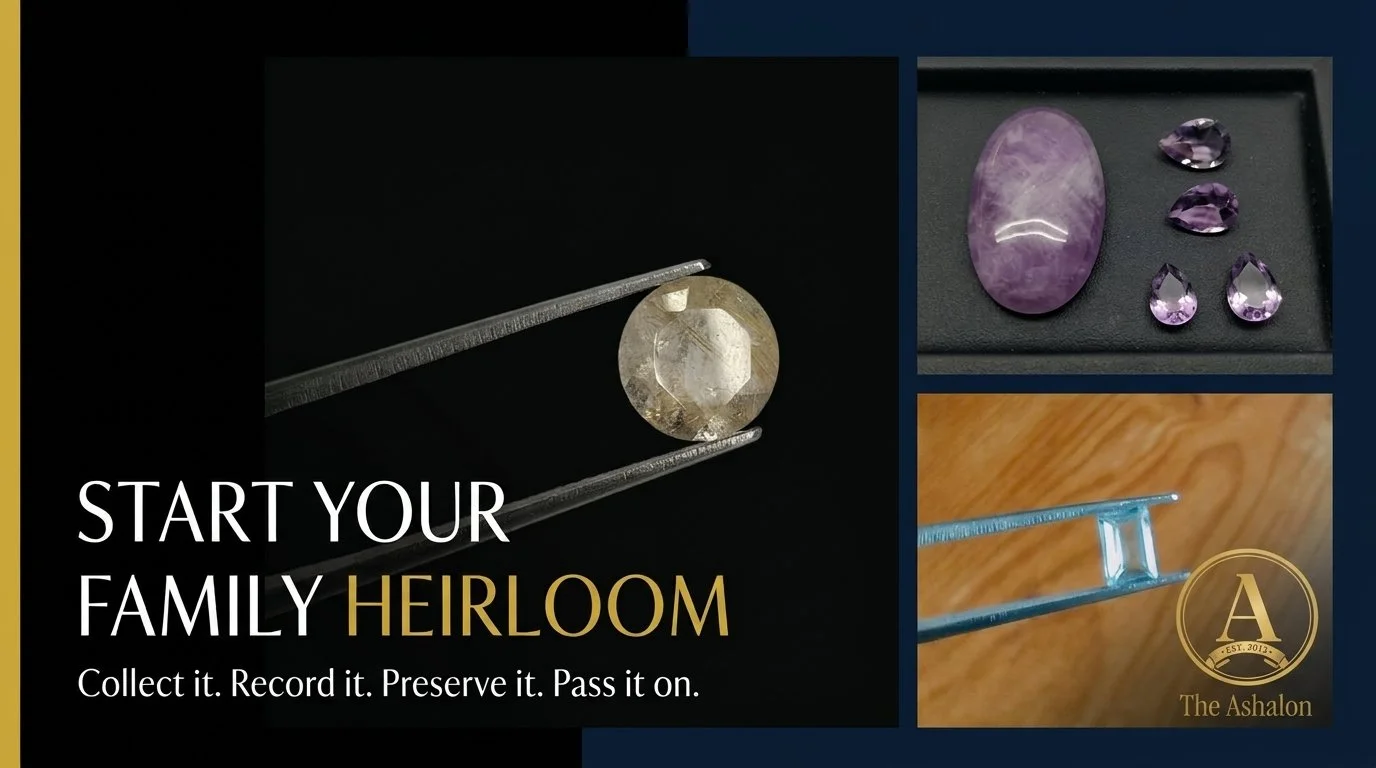
A family heirloom does not have to be inherited. You can start creating one today.
In a world where photographs live on phones, memories sit in cloud storage and so much of our identity exists online, there is something special about owning an object you can physically hold, protect and eventually pass on to someone you love.
At The Ashalon™, we believe that every family should have the opportunity to build its own legacy. You do not need to be wealthy, own an antique collection or wait until you inherit something from a relative. You can begin with one meaningful object, record its story and preserve it for the future.
That object could be a coin, a historical document, a banknote, a piece of jewellery or a gemstone that captures your imagination.
Our philosophy is simple:
Collect it. Record it. Preserve it. Pass it on.
As a London-based legacy asset agency specialising in gemstones, numismatics, historical documents and tangible heritage assets, The Ashalon encourages people to look beyond what an object costs and consider what it could mean to the people who inherit it.
Because sometimes the smallest object can become one of the most memorable things a family owns.
What Is a Family Heirloom?
A family heirloom is an object preserved and passed between generations because it carries personal, historical or cultural significance.
Some heirlooms have been in families for centuries. They might include a grandfather's watch, a grandmother's wedding ring, an old family photograph, a handwritten letter or a document connected to a significant moment in a family's history.
Other heirlooms begin with a simple decision made today.
A parent might purchase a gemstone to mark the birth of a child. Someone starting a business might choose an object to commemorate the day they took the first step. A couple might collect a stone each year to represent a milestone in their relationship. A young collector might purchase a coin from a country they hope to visit.
Over time, the object becomes connected to the people, experiences and decisions surrounding it.
Its importance is no longer determined solely by its material composition or resale price. It also reflects the memories attached to it.
Imagine a child receiving a gemstone from a parent twenty years from now. The stone may be small, but a handwritten note explaining why it was purchased, what was happening in the family at the time and what the parent hoped for their child could make it far more meaningful.
The gemstone becomes a physical reminder of a person and a moment in history.
That is how an object can become an heirloom: someone chooses to preserve it, and someone takes the time to preserve its story.
Why Start Your Family Heirloom Now?
Many people associate heirlooms with old age, inheritance or wealthy families. This creates the impression that legacy building is something to consider later in life.
We believe that is the wrong way to approach it.
Your family's history is being created right now. Your achievements, challenges, celebrations, relationships and everyday experiences are all part of the story future generations may want to understand.
Starting a family heirloom today gives you the opportunity to decide what you want to preserve.
1. Give Your Family Something Tangible
Digital records are useful, but physical objects offer a different experience.
A gemstone can be held in the hand. A coin can be examined closely. A letter can be read in the handwriting of the person who wrote it. An old banknote can reveal how a country represented its identity at a particular point in history.
These objects provide physical connections to the past.
They can also encourage conversations between generations. A child might ask why a particular gemstone was chosen, where a coin came from or why a document was important to a grandparent.
Those questions create opportunities to share family stories that might otherwise never be told.
2. Preserve More Than Money Can Measure
It is natural to consider the price of an object before purchasing it. However, the price paid is only one part of the ownership experience.
A gemstone might be chosen because its colour reminds someone of a favourite place. A coin might represent a country connected to a family's heritage. A historical document might relate to a person's career, education or achievements.
None of these reasons requires the object to increase in financial value.
At The Ashalon, we encourage responsible collecting based on genuine interest, appreciation and the desire to preserve meaningful possessions. Gemstones and collectibles can fluctuate in price, and there is no guarantee that an item will appreciate or be easy to resell.
An heirloom can be worthwhile because of what it represents, even if its market price never changes.
3. Create a Record of Your Life
Think about the possessions you have inherited or discovered among your relatives' belongings.
How many came with a complete explanation of who owned them, when they were acquired or why they were kept?
Often, the object survives while its story disappears.
Starting your own collection gives you the opportunity to prevent that from happening. You can record the date of purchase, the reason for choosing the object, any known provenance and the people connected to it.
You can also include photographs, letters and personal reflections.
A future family member might not remember the circumstances surrounding your purchase, but a written record can help them understand why it mattered.
4. Make Legacy Building Accessible
Creating a family heirloom should not be reserved for people who can afford expensive antiques or jewellery.
A meaningful collection can start with a modest purchase and develop gradually as your interests and budget allow.
At The Ashalon, selected heritage assets are offered at accessible prices, with some items available from as little as £5. You can begin with one object and add others over time, rather than feeling pressured to acquire an entire collection immediately.
The objective is not to spend more money. It is to become more intentional about what you choose to keep.
Three Gemstones That Could Begin Your Family Heirloom
Gemstones offer a particularly interesting starting point for a personal collection. They are physical objects formed through natural geological processes, and their colours, inclusions, shapes and characteristics can make each specimen interesting to examine.
The Ashalon has three examples worth exploring if you are considering your first gemstone heirloom.
These are not presented as guaranteed investments. They are examples of how different gemstones can inspire different collecting interests and become part of a personal story.
1. Rutile Quartz: A Gemstone That Invites Curiosity
Explore the Mesmerizing Rutile Quartz Gemstone — 155 Carats.
Rutile quartz is fascinating because of the visual relationship between the quartz and the needle-like inclusions of rutile that may be visible within it.
Rather than seeing only a polished stone, the observer can explore the patterns and features within the material. These internal characteristics can make a specimen an engaging conversation piece for someone interested in mineralogy, natural formations or unusual gemstones.
For a family beginning a collection, a rutile quartz specimen could represent curiosity: the desire to look more closely at the natural world and ask questions about how things form.
Imagine passing it to a child alongside a note explaining why you selected it. That note could encourage them to investigate quartz, learn about mineral inclusions and develop an interest in geology.
The stone becomes a starting point for learning as well as an object to preserve.
A possible heirloom story: “I chose this stone because I wanted our family collection to include something that reminds us to look closely, stay curious and keep learning.”
That is only one possible interpretation. The story should ultimately be your own.
2. Brazilian Amethyst: A Collection Built Around Colour and Meaning
Explore the Natural Brazilian Amethyst Collection.
Amethyst is a purple variety of quartz and a familiar gemstone for collectors and jewellery enthusiasts. Its range of purple tones can make it an appealing choice for someone who appreciates colour, mineral specimens or gemstone collecting.
Brazil has a long association with amethyst production, making Brazilian amethyst a useful starting point for learning about gemstone sourcing and the relationship between geological materials and the places where they are found.
The collection format also offers a different approach to heirloom building. Instead of focusing on one individual stone, a collection can become a record of a person's changing interests or a series of meaningful occasions.
You might keep one stone to commemorate a birthday, another to mark a family achievement or a selection to represent different stages of your life. Alternatively, you might simply enjoy the stones and preserve them together as part of a growing collection.
Amethyst is also the traditional birthstone associated with February, which may make it an appealing personal gift for someone born in that month.
However, a gemstone does not need a birthstone connection or a special occasion to become meaningful. You can choose it simply because you appreciate it.
A possible heirloom story: “I began collecting amethyst because I loved its colour. Over time, the collection became a record of the moments and people I wanted to remember.”
The significance comes from the meaning you attach to the collection, not from a promise of future financial returns.
3. Natural Aquamarine: Marking a Personal Milestone
Explore the 1-Carat Natural Aquamarine Gemstone.
Aquamarine is a blue to blue-green variety of beryl, the same mineral family that includes emerald. Its colour can evoke water, open skies and coastal landscapes, making it an appealing choice for someone drawn to blue gemstones.
A one-carat gemstone can also provide a manageable starting point for learning about gemstone characteristics, including colour, cut, clarity and the information available about a stone's identity and treatment.
For a family heirloom, aquamarine could be chosen to commemorate a new beginning: a graduation, a first job, a business launch, a wedding or a personal achievement.
The object itself does not need to explain the milestone. You can record that connection in a note and preserve it alongside the gemstone.
Years later, a relative might discover the stone and learn about the day it was purchased, the ambitions you had at the time and the circumstances that shaped your life.
A possible heirloom story: “This was the gemstone I chose to mark a new chapter. I kept it to remember where I started and what I hoped to achieve.”
As with any gemstone, its quality and market value depend on its individual characteristics and other relevant factors. Natural origin alone does not guarantee rarity, premium value or appreciation.
The reason to choose an aquamarine for your heirloom should begin with your own interest in the stone and the story you wish to preserve.
How to Start Your Family Heirloom in Five Steps
You do not need to build a large collection immediately. Begin with one object and a simple plan.
Step 1: Choose Something You Genuinely Appreciate
Start with an object that interests you.
It could be a gemstone, coin, banknote, historical document, piece of jewellery or another collectible. Consider what attracts you to it. Is it the colour, the history, the craftsmanship, its connection to a country or the memory it represents?
Do not choose something solely because you believe its price will rise.
Step 2: Record the Facts
Write down what you know about the object.
For a gemstone, this might include its name, stated carat weight, dimensions where available, purchase date, seller and any documentation supplied. For a coin or banknote, you might record the issuing country, denomination, date and relevant historical context.
Clearly distinguish verified information from personal assumptions. If the origin, treatment or authenticity has not been independently established, do not record it as a confirmed fact.
Keep receipts, certificates and supporting documentation where applicable.
Step 3: Write the Story Behind Your Choice
This is where the heirloom begins to become personal.
Write a short note explaining:
Who purchased or received the object.
When and why it was acquired.
What was happening in your life at the time.
What you would like future generations to know about it.
Who you hope will eventually look after it.
You do not need to write a memoir. A few honest sentences can preserve details that might otherwise be forgotten.
Step 4: Store It Properly
Preservation requires practical care.
Keep gemstones in suitable protective storage, avoid unnecessary contact with harder materials that could scratch them and follow care guidance appropriate to the particular stone and any treatments it may have received.
Store documents in suitable archival conditions and protect them from moisture, excessive light and avoidable handling. Keep digital copies of relevant records, but do not rely on a single digital location for your only copy.
Good preservation helps protect both the object and the information associated with it.
Step 5: Pass on the Object and Its Record
An heirloom becomes more useful to future generations when they understand what it is and why it was kept.
Tell your family about the collection. Make sure important records can be found. Consider documenting who should receive particular objects and review those wishes as circumstances change.
Where appropriate, seek professional advice on estate planning and the legal transfer of valuable possessions.
The goal is to make the object and its story easier to preserve together.
The Ashalon Digital Ledger™: Record More Than Ownership
At The Ashalon, we believe that collecting is only one part of preserving heritage. Documentation matters too.
The Ashalon Digital Ledger™ is designed to help record information about tangible heritage assets, including:
Object: What the item is.
Origin: What is known about where it came from.
Date: Relevant dates, such as acquisition or documented creation.
Meaning: Why the object matters to its owner.
Owner: Ownership information, where the owner chooses to record it.
The idea is straightforward: help preserve the information that gives an object context.
A gemstone without a record can still be beautiful. A gemstone accompanied by a careful description, purchase date and personal story offers future custodians more information to work with.
The Ledger is intended to support the preservation of records, not replace original certificates, receipts, legal ownership documents or independent verification of an object's characteristics.
For families, the broader principle is worth adopting even before using a formal system: keep the object together with its story.
Why The Ashalon Believes Every Family Can Build a Legacy
The Ashalon was founded in 2013 and has developed into a London-based legacy asset agency focused on gemstones, numismatics, historical documents and tangible heritage assets.
Our wider ambition is to encourage people to take an active interest in what they own and what they leave behind.
We recognise that families have different histories, cultures, financial circumstances and priorities. Not every family will want to collect gemstones, and no single object can represent every person's story.
For some, a handwritten recipe will matter more than a gemstone. For others, a coin, a family photograph, a medal or a document will hold the strongest connection to the past.
The principle remains the same: preserve what matters to you and make its significance understandable to the people who come after you.
We also believe that collecting should be responsible. Buy within your means, ask questions about what you are purchasing, retain relevant documentation and do not treat a collectible as a guaranteed financial asset.
A legacy is not measured only by the size or monetary value of an estate. It can also be measured by the care taken to preserve the objects, memories and knowledge that future generations receive.
Begin with Something Small. Give It a Story.
You do not need to wait until you are older, wealthier or ready to create a large collection.
You can start today.
Choose a gemstone that catches your eye. Preserve a coin that represents a place you love. Find a document that tells you something about your family. Write down why it matters, keep the record safe and make a plan for how it can be passed on.
Perhaps the object will remain in your family for decades. Perhaps it will inspire a younger relative to begin a collection of their own. Perhaps it will simply remind someone of you.
You cannot predict exactly what meaning a future generation will find in an object. But you can give them the opportunity to discover it.
Explore these examples from The Ashalon:
Browse more items through The Ashalon Estate Assets, where selected assets offer an accessible starting point for new collectors.
Your family history is being created every day. Start preserving a piece of it.
The Ashalon™ — Freedom. Assets. Control.
Collect it. Record it. Preserve it. Pass it on.