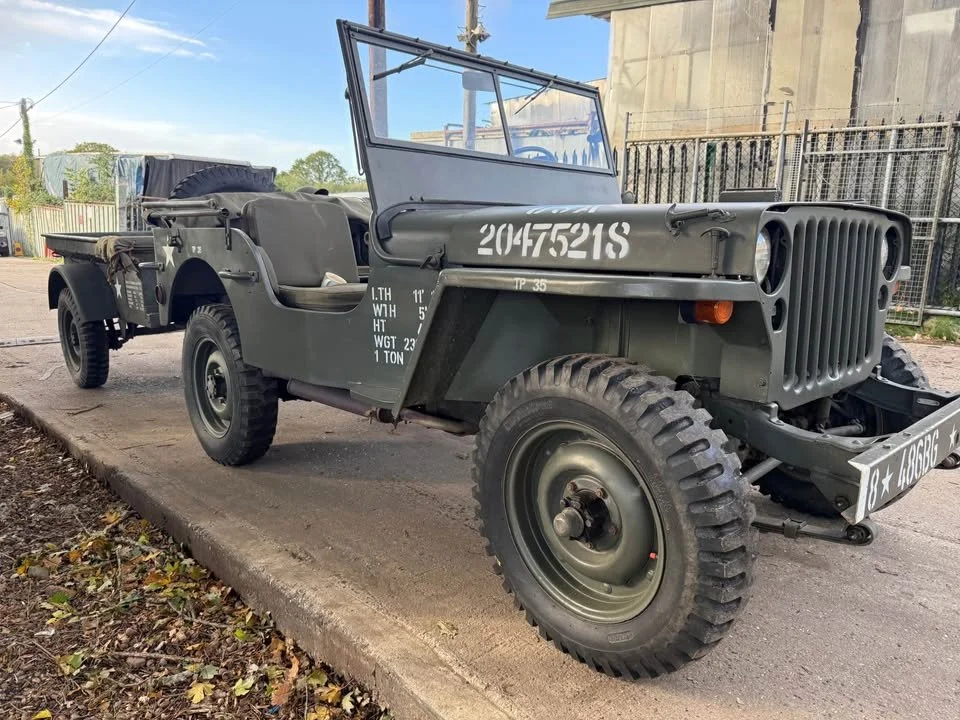
Discover the history, engineering and enduring appeal of the 1943 Willys MB 4x4 Jeep, accompanied by an original Bantam trailer, featured in The Ashalon Estate collection.
Some objects tell a story through their appearance. Others carry the history of an entire generation. The 1943 Willys MB 4x4 Jeep is one of those remarkable machines: a vehicle closely associated with the Second World War, military engineering and the development of the modern four-wheel-drive automobile.
Featured in The Ashalon Estate collection, this 1943 Willys MB is presented alongside an original Bantam trailer. Together, they offer an opportunity to appreciate an important chapter in motoring and military history through two tangible pieces of historic vehicle heritage.
Listed at £35,000, this example is described as a highly original vehicle that underwent an older restoration by a noted collector. The listing reports that the original engine and gearbox remain in place, that the Jeep has covered approximately 1,000 kilometres since the restoration, and that it is accompanied by its original Bantam trailer.
For collectors of classic military vehicles, enthusiasts of historic motoring and individuals interested in preserving tangible heritage, the 1943 Willys MB represents far more than an old four-wheel-drive vehicle. It is a connection to an era when practical engineering, mobility and mechanical simplicity played an important role in global events.
The Birth of the Military Jeep
The story of the Willys MB begins in 1940, when the United States Army sought a compact, lightweight, four-wheel-drive vehicle capable of operating across difficult terrain. The military required a versatile vehicle that could transport personnel, carry equipment, support reconnaissance and perform a range of duties in demanding conditions.
The requirement was ambitious. The vehicle needed to be small enough to manoeuvre across challenging ground, strong enough to carry useful loads and mechanically capable of operating away from established roads.
The US Army approached the American automotive industry, inviting manufacturers to submit proposals. Among the companies involved in the development process were American Bantam, Willys-Overland and Ford.
American Bantam played an important early role in the development of the military reconnaissance vehicle concept. Its prototype helped establish the direction of the project, while subsequent development and testing incorporated contributions from the competing manufacturers.
Willys-Overland developed the vehicle that became the Willys MB. Its powerful-for-its-class engine and practical four-wheel-drive design helped establish the production model that would become one of the best-known military vehicles of the Second World War.
The Willys MB entered production in 1941 and continued through 1945. During this period, the Jeep became widely used by Allied military forces across different theatres of the conflict.
The vehicle's influence extended beyond wartime service. Its practical design helped establish the foundations of the civilian four-wheel-drive vehicles that followed.
Why the 1943 Willys MB Became an Icon
The Willys MB was designed around usefulness rather than luxury. Its straightforward bodywork, compact proportions, open cabin, fold-down windscreen and four-wheel-drive capability reflected the practical demands placed upon a wartime military vehicle.
The Jeep's versatility was one of its defining qualities. It could be adapted to transport personnel, carry equipment, support communications, assist medical teams and undertake reconnaissance duties. Its ability to travel over difficult ground made it valuable in environments where conventional road vehicles were less suitable.
The design was also relatively uncomplicated compared with larger and more specialised military vehicles. Its mechanical layout and practical construction helped make it suitable for military use, maintenance and adaptation.
The Willys MB became a familiar sight across the Second World War. Its association with Allied military service helped establish its place in the history of twentieth-century motoring.
Today, the wartime Jeep remains a recognisable classic vehicle. Collectors appreciate its historical associations, functional design and role in the development of four-wheel-drive motoring.
The 1943 example featured by The Ashalon provides a way to explore this history through a specific surviving vehicle rather than simply reading about the model in a history book.
The Willys MB and the Development of Four-Wheel-Drive Motoring
The importance of the Willys MB extends beyond its military origins.
The Second World War accelerated the development of practical vehicles capable of operating in difficult conditions. The Jeep demonstrated how a compact four-wheel-drive platform could provide mobility across terrain that presented challenges to conventional vehicles.
Its success helped establish the appeal of small, versatile off-road vehicles. After the war, Willys-Overland developed civilian versions of the Jeep, beginning with the CJ-2A in 1945.
The transition from military Jeep to civilian utility vehicle illustrates how engineering developed for wartime requirements could find a lasting place in everyday life.
The Willys MB therefore occupies an important position in the history of the four-wheel-drive automobile. Its influence can be seen in the development of later off-road vehicles, utility vehicles and recreational four-wheel-drive models.
For classic car collectors, the Willys MB is consequently interesting from several perspectives: military history, American manufacturing, automotive engineering and the evolution of off-road motoring.
The Original Bantam Trailer: An Important Companion
One of the particularly interesting features of this Ashalon listing is the inclusion of an original Bantam trailer.
American Bantam is closely connected to the early development of the military Jeep. Although the company did not become the principal mass producer of the Willys MB, it played an important role in the early history of the military reconnaissance vehicle programme.
Bantam also became associated with military trailers designed to support the transportation of equipment and supplies.
A trailer accompanying a wartime Jeep adds another dimension to the presentation. It allows the vehicle to be considered as part of a wider military transport arrangement rather than simply as a standalone automobile.
For collectors, the combination of a Willys MB and Bantam trailer is particularly appealing because it brings together two names associated with the development of American military transport during the Second World War.
The Ashalon listing describes the accompanying trailer as an original Bantam trailer and states that it can be purchased with the Jeep or separately. Prospective buyers should confirm its identification, provenance, condition and any available supporting documentation during the viewing process.