The Ashalon acquires an approximately 190-carat emerald doublet associated with Bogotá, Colombia, bringing a striking green gemstone into its developing Estate and championing a simple idea: everyone should have the opportunity to build a legacy, starting with as little as £5.
By The Ashalon | 13 October 2026
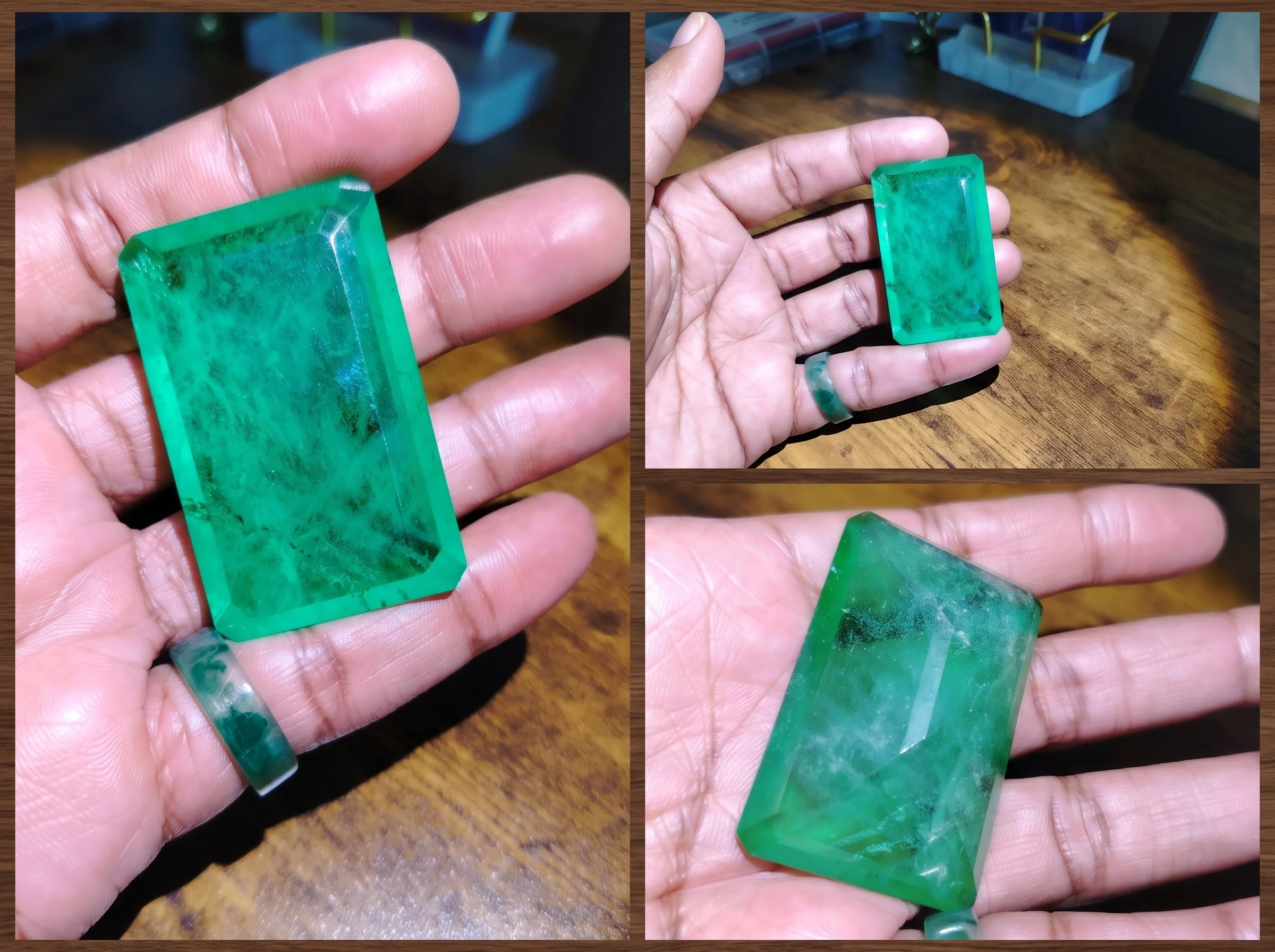
There are objects we admire for their beauty. There are objects we collect because of their rarity. And then there are objects that make us stop, look again and think about what we might leave behind. For The Ashalon, its newly acquired, approximately 190-carat emerald doublet is all about that third possibility. Held in the hand, the stone has an unmistakable presence. Its rectangular emerald cut creates a broad, geometric face, while its vivid green perimeter frames a cloudy, heavily included centre. Light travels differently across its polished surfaces, revealing variations in colour, texture and transparency. The internal features give the piece a character of its own, inviting closer inspection rather than demanding a passing glance. It is a substantial object, visually distinctive and capable of starting a conversation.
But the real story is not simply that The Ashalon has acquired a large emerald doublet. It is what the acquisition represents.
The Ashalon is building a collection of tangible heritage assets with the ambition of inspiring people to collect, document and preserve objects that matter to them. Its Estate includes the developing world of gemstones, numismatics, historical documents, jewellery and other collectibles. Each acquisition contributes to that wider vision: to demonstrate how physical objects can carry stories, and how those stories can become part of a legacy.The emerald doublet is one of the Estate's centrepieces. The £5 gemstone that somebody chooses as their first collectible can be the beginning of the same journey.
One object may command attention because of its size. Another may become priceless to a family because of the memory attached to it. The Ashalon wants to make room for both.
Meet the Emerald: A Striking Object With a Story to Tell
The Ashalon's newly acquired emerald doublet is described as weighing approximately 190 carats and having been acquired in connection with Bogotá, Colombia. Its substantial rectangular form, emerald cut and vivid green appearance make it an arresting addition to the collection. In the photographs, the object sits across the palm of a hand, offering a direct sense of its physical scale. The face reveals extensive internal inclusions, with areas of darker green and cloudy material visible beneath the polished surface. The piece is not presented as a flawless gemstone. Its character comes from the relationship between its size, colour, cut, internal features and construction. That distinction matters because gemstones are often discussed through a narrow vocabulary of perfection, clarity and price. Real collecting is more interesting than that. Different objects have different characteristics, and understanding those characteristics is part of the pleasure of ownership. The Ashalon describes the piece as an emerald doublet made predominantly from Colombian emerald rough. The material is heavily included and has been oiled, contributing to the appearance of the emerald material.
A doublet is an assembled gemstone, rather than one naturally formed crystal. Its construction must be distinguished from that of a single solid emerald, and the stated approximate 190-carat weight refers to the assembled object. This is not a small technicality to bury in the fine print. It is an important part of the object's identity.The Ashalon believes that being open about what an object is, how it is described and what is known about it makes collecting more rewarding. Customers should be able to appreciate an object without being misled about its composition, treatment or origin.
The emerald doublet has a story worth telling precisely because there is more to it than its impressive dimensions.
Colombia, Emeralds and the Journey From Earth to Collection
Colombia occupies an important place in the international emerald trade. Colombian emeralds are renowned for their green colour and have been collected, cut, traded and incorporated into jewellery for generations. Emerald is the green variety of beryl, a mineral whose colour is associated principally with trace amounts of chromium and, in some cases, vanadium. Emeralds form under particular geological conditions, and their internal characteristics can preserve evidence of the environments in which they developed.
Inclusions are especially relevant to emeralds. Some stones contain mineral crystals, fractures and fluid inclusions that gemmologists study to understand their characteristics and investigate possible geographic origin. These internal features are not simply imperfections to be overlooked. They can be part of the scientific story of a gemstone. That does not mean every inclusion proves where a stone came from. Origin assessment can require specialist examination and a combination of evidence. Nor does the fact that an object was purchased in Bogotá establish the precise mine from which its material originated. For this acquisition, The Ashalon describes the doublet as being made predominantly from Colombian emerald rough and associates its acquisition with Bogotá. Any more specific claim about its geological origin should be supported by suitable documentation or independent gemmological assessment.
That careful distinction is part of preserving a credible heritage record. An object has a physical identity, but its history also depends on the evidence available to support the claims made about it. Recording what is known, while acknowledging what has not been independently established, gives future custodians a more reliable foundation for understanding what they own. For The Ashalon, the emerald doublet creates an opportunity to explore the connection between natural materials, the international gemstone trade, human craftsmanship and the collections in which objects eventually find a home.
A gemstone begins its story long before it reaches a collector. The collector's role is to understand it, preserve it and, where possible, record that story for the future.
Oil, Inclusions and the Beauty of Understanding What You Own
The emerald material in the doublet is described as heavily included and oiled. Both details are relevant to understanding its appearance.
Emeralds commonly contain internal characteristics, including fractures and mineral or fluid inclusions. The extent and nature of those features vary considerably between stones. In some cases, fractures can affect transparency and durability, while other inclusions provide useful material for gemmological investigation. Oil treatment is widely encountered in emerald trading. Oils or other filling substances may be introduced into surface-reaching fractures to make them less visible and improve the stone's apparent clarity. The type and degree of enhancement matter when describing, assessing and caring for an emerald. Treatment does not automatically determine a gemstone's value, and it should not be confused with proof of geographic origin. Likewise, heavy inclusion does not, by itself, establish that a gemstone is rare or valuable.
The overall object must be considered in context: its construction, dimensions, appearance, treatment, condition, documentation and the market for comparable material. For The Ashalon, this is not a reason to diminish the emerald doublet's appeal. It is an invitation to look more closely. The piece offers an opportunity to explain why two objects that appear similar at first glance may differ significantly in composition and treatment, and why a collector should ask questions before purchasing. It also reflects a wider philosophy: the more we understand an object, the better equipped we are to preserve its story. The Ashalon wants collecting to be approachable without making it superficial. People do not need to become gemmologists before buying their first gemstone, but they should be encouraged to learn, ask questions and keep the information supplied with their acquisitions.
An informed collector is better placed to care for an object and explain its significance to the next person who owns it.
Why The Ashalon Is Building an Estate
The Ashalon Estate is being developed as a growing collection of gemstones, numismatics, historical documents, jewellery and other tangible heritage assets. Its long-term ambition is to build a collection that can support research, documentation, preservation, public engagement and future exhibitions. The wider vision includes developing a recognised heritage collection with museum-quality aspirations. The emerald doublet contributes to that developing collection by offering a distinctive object around which The Ashalon can create educational material and engage with collectors and the public. But the Estate is not being developed solely to accumulate impressive possessions. The Ashalon wants its collection to demonstrate what collecting can mean to people. It wants visitors to encounter an object and leave with a question, an idea or the inspiration to start something of their own. The company also uses an internal, self-assessed estimate to communicate the developing scale of its Estate. An acquisition such as this may contribute to that internal assessment, but an internal estimate is not the same as an independent professional valuation, a formal insurance valuation or a confirmed market price.
These distinctions matter. Acquisition cost, insurance value, estimated resale value and an owner's assessment of an object's significance can all be different. The Ashalon is interested in building a collection, but it also wants to encourage responsible collecting. That means keeping clear records, describing objects accurately, preserving supporting documents and avoiding promises that a collectible will appreciate in value. The Estate's ambition is to grow in both substance and credibility. The emerald doublet gives the public a tangible example of that ambition. Its scale makes it memorable; its construction makes it interesting; and its place within the Estate helps communicate the purpose behind the collection. Yet the Estate's success should not be measured only by the price or size of its most impressive objects. It should also be measured by the number of people it inspires to preserve their own histories.
A Legacy Should Not Be Reserved for the Wealthy
There is a common misconception that collecting is something people do after they have accumulated significant wealth. Luxury auctions, rare diamonds, historic manuscripts and museum collections can reinforce the impression that ownership of interesting objects belongs to a small group of affluent people. The Ashalon wants to challenge that assumption. A family heirloom does not have to be expensive. It does not need to be an antique, and it does not have to be inherited from a previous generation. It can begin with an object chosen today and preserved with intention.
A gemstone might be selected because it is someone's favourite colour. A coin might represent a country where a family has roots. A banknote might remind someone of a memorable journey. A document might mark a wedding, an achievement or a turning point in a family's history. The object matters, but so does the meaning attached to it. Imagine a parent purchasing a small gemstone for a child. Alongside it, they record the date, the reason for choosing it and a short message explaining what it represents. Years later, the child may still have the stone, but they will also have the story of why it was given. That record can be passed on with the object. A future family member may add another memory, turning a simple purchase into a continuing family narrative.
This is the kind of possibility The Ashalon wants to encourage.
The company's message is not that every collectible will become financially valuable, nor that an object automatically becomes an heirloom simply because it has been purchased. The point is that people can deliberately preserve meaningful objects and the information that gives them context.
You do not need to inherit a legacy before you begin creating one.
That belief is at the heart of The Ashalon's accessible approach to heritage collecting.
Start Your Own Heirloom From as Little as £5
The emerald doublet may be a centrepiece of The Ashalon Estate, but it is not the price of entry into the world of collecting. The Ashalon offers selected heritage assets from as little as £5. Customers can browse the Estate Assets section of the website to discover available gemstones, coins, banknotes, historical documents and other collectibles. A first purchase can be modest. The collection can grow as interests develop and opportunities arises. Someone beginning with gemstones might gradually learn about colour, clarity, treatments, mineral properties and geographic origin. A coin collector might develop an interest in the history of currency, the changing identities of nations or the people and events depicted on coins. Someone interested in family history might start preserving documents and objects that help tell the story of their relatives. There is no single correct way to start.
The Ashalon encourages people to choose objects they genuinely appreciate, understand the information available about them and consider how they might preserve them. Collecting should fit within a sensible personal budget, and purchases should not be made on the assumption of a guaranteed financial return. An affordable collectible can be the beginning of a meaningful personal project. It can also be a gift, a conversation starter or the first entry in a growing record of objects.
The important step is to begin.
To explore available assets, visit The Ashalon website and browse the Estate Assets section.
You might find a gemstone that speaks to you, a coin that connects you to a place or period, or a document that inspires you to learn more about history. Whatever the first acquisition may be, it can become an opportunity to begin recording your own story.
The Ashalon Digital Ledger™: Preserving More Than the Object
An object can survive for decades or centuries while its story disappears.
A gemstone might remain in a jewellery box long after its original owner has passed away. A coin might be inherited without anyone remembering how it entered the family. A historical document might be kept carefully but eventually lose the context that made it important. The Ashalon Digital Ledger™ is intended to help customers create records of their tangible heritage assets. Depending on the information available, a record may include the object's description, origin, acquisition date, significance and ownership details. The aim is to connect the physical object with information that helps explain what it is and why it matters. For example, a customer might record the circumstances of purchasing a gemstone, document a coin's known history or preserve the story behind a family document. The Ledger is part of The Ashalon's wider philosophy: collect an object, record what is known about it and preserve the information that may help future custodians understand it. The company is also preparing to launch a History Capture Service, intended to help customers preserve documentation and place relevant records on the Ledger.
This planned service could be particularly useful for families with letters, photographs, certificates and other historical documents that they want to organise and preserve. Instead of relying entirely on memory, families would have an opportunity to record information that helps future generations understand their history. The exact scope, availability and access arrangements for the History Capture Service will be confirmed by The Ashalon as the service develops. Customers should consult the website for details about document handling, privacy and record access. The wider ambition is to make heritage easier to preserve and trace through better documentation.The emerald doublet itself illustrates why such records matter. Its physical appearance is only one part of its story. Its composition, treatment, acquisition details and supporting evidence are also relevant to anyone who wants to understand it.
A well-kept record does not make an object more historically important by itself, but it can help preserve the information that future owners need to interpret it responsibly.
See the Emerald Doublet at The Ashalon Invitationals
For those who want to see the emerald doublet beyond the photographs, The Ashalon is inviting guests to attend The Ashalon Invitationals, a free event designed to introduce visitors to the company, its collection and its approach to heritage collecting. The event will include a poker tournament taking place in the background, while guests have the opportunity to learn about The Ashalon, discover its assets and explore the idea of creating a family heirloom. The emerald doublet is intended to be a centrepiece of the experience. Seeing it in person allows visitors to appreciate its dimensions, vivid green colour, polished surfaces and internal features in a way that a photograph cannot fully reproduce.
Subject to the event's handling arrangements, guests may also have the opportunity to hold the object.
For those unfamiliar with gemstones, this can be an opportunity to ask questions about the difference between a natural crystal and a doublet, what inclusions can tell us, how oil treatment is used and why accurate descriptions matter when collecting. The Ashalon also intends to welcome guests with free gifts. The purpose is to create an approachable introduction to the company and inspire visitors to think about the objects, documents and memories they might like to preserve. The event is not only for experienced collectors. People who have never purchased a gemstone, coin or historical document are welcome to explore the idea of collecting and learn how to begin.
Attendance is free, but guests should obtain tickets in advance.
Get your free event ticket or find out more at theashalon.co.uk/free-roll.
Anyone wishing to play in the poker tournament must visit the website and apply for a seat separately. A general event ticket should not be assumed to guarantee a place in the tournament. The Ashalon Invitationals offers an opportunity to meet the company, explore the developing Estate and consider how a single object can become the start of something personal.
The Meaning of Ownership: Freedom, Assets and Control
The Ashalon's philosophy is expressed through three words: Freedom. Assets. Control.
For the company, tangible ownership is not simply about acquiring possessions. It is also about making considered choices about what we value, what we preserve and what we want future generations to know. A collection can reflect an individual's interests, family background, travels, achievements or curiosity about the world. It can grow slowly, change direction and develop a character of its own. The ability to choose what to collect is part of that process. So is the ability to record an object's history rather than allowing its story to disappear.
The emerald doublet is an impressive example of a tangible object that attracts attention and invites investigation. But The Ashalon does not believe that the meaning of a collection depends on owning the biggest, rarest or most expensive piece. A modest collection can be just as personal. One coin, one gemstone or one document can become a starting point for learning and preservation.
The company wants its Estate to inspire that sense of possibility. Rather than presenting collecting as a distant world reserved for specialist dealers and wealthy buyers, The Ashalon wants to make it approachable to families, beginners and people who simply enjoy objects with stories. That is why the £5 starting point matters. It turns an abstract idea about legacy into something a person can act on today.
What Comes Next for The Ashalon Estate?
The acquisition of the approximately 190-carat emerald doublet is another step in the development of The Ashalon Estate and its long-term ambition to create a collection of tangible heritage assets with educational and cultural interest. Future development will depend on responsible acquisition, documentation, preservation, research and opportunities to share the collection with the public. The planned History Capture Service and the Digital Ledger are part of that broader direction: helping people preserve information alongside physical objects, rather than treating the object as the entire story. As the Estate develops, The Ashalon aims to create more opportunities for customers and visitors to discover gemstones, numismatics, historical documents and other collectibles, while learning about the importance of recording and preserving them.
The emerald doublet is a striking symbol of that ambition, but the company's purpose reaches beyond one acquisition.
It is about encouraging people to begin. A person may visit The Ashalon because they are fascinated by the emerald. They may leave thinking about the coin in a drawer at home, the documents kept by a grandparent or the gemstone they could purchase for a child. That is the connection The Ashalon wants to make: from a remarkable object in a growing Estate to the ordinary objects that families choose to preserve.
Your Story Starts Here
The approximately 190-carat emerald doublet is a substantial and distinctive addition to The Ashalon Estate. Its green colour, emerald cut, inclusions and composite construction make it an object worth examining and discussing. But its greatest role may be the inspiration it provides. It reminds us that collections begin with individual choices. They grow when people take an interest in the objects they own, learn about their history and record the information that makes them meaningful. You do not need a large budget to begin. You do not need to be an expert. And you do not need to wait for an inheritance to start preserving your family's story.
Begin with something you appreciate. Record why it matters. Take care of it. Let the story develop The Ashalon invites you to explore its Estate Assets, discover available collectibles from as little as £5, and learn more about the Digital Ledger and the forthcoming History Capture Service. If you would like to see the emerald doublet in person, join The Ashalon at its free Invitationals event and discover the company, its collection and its approach to family heirlooms.
Collect it. Record it. Preserve it. Pass it on.
Your story starts with one object.
Explore The Ashalon
Browse Estate Assets: https://www.theashalon.co.uk/
Attend The Ashalon Invitationals: https://www.theashalon.co.uk/free-roll & The Ashalon Invitationals Guest list
Discover The Ashalon Digital Ledger™: Visit the website for information on collection recording and the planned History Capture Service.
About The Ashalon
The Ashalon™ is a London-based legacy asset agency focused on gemstones, numismatics, historical documents, jewellery, collectibles and tangible heritage assets. Founded in 2013, the company helps people collect, record and preserve objects that carry history, identity and personal meaning. Through The Ashalon Estate, its Collectors Society, the Digital Ledger and its events, The Ashalon aims to inspire more people to create and preserve family heirlooms.
Editorial and Gemmological Note
The emerald doublet is described by The Ashalon as weighing approximately 190 carats, being made predominantly from Colombian emerald rough, and having been oiled. The object is a doublet, meaning it is assembled rather than a single solid emerald crystal. Its stated association with Bogotá, Colombia, should not be treated as independent verification of the precise geological origin of all constituent material. No independent valuation, certificate or laboratory origin report has been asserted in this article.
References and Further Reading
Gemological Institute of America (GIA) — Information on imitation and assembled gemstones: https://www.gia.edu/UK-EN/gem-imitation
GIA — Research and laboratory notes on emerald doublets: https://www.gia.edu/gems-gemology/spring-2016-labnotes-emerald-doublet
GIA — Research on inclusions in natural, synthetic and treated emeralds: https://www.gia.edu/gems-gemology/winter-2016-inclusions-natural-synthetic-treated-emerald
GIA — Background on emeralds, clarity and treatment: https://4cs.gia.edu/en-us/blog/diamonds-vs-emeralds/
GIA — Research on geographic origin determination of emeralds: https://origin.prod.gia.edu/gems-gemology/winter-2019-emerald-geographic-origin-determination
The Ashalon — Company website, Estate Assets and event information: https://www.theashalon.co.uk/