Should You Buy a Signed Fernando Alonso Aston Martin F1 Hat? The Ashalon’s Case for Collecting What You Love
Should You Buy a Signed Fernando Alonso Aston Martin F1 Hat? The Ashalon’s Case for Collecting What You Love
The Ashalon asks a simple question: would you buy it if you never sold it?
There is something increasingly strange about the way people talk about collecting. A watch is immediately discussed in terms of resale value. A rare coin becomes an investment vehicle. A gemstone becomes an asset class. A signed football shirt is judged by auction prices. Even a Formula 1 hat can become a conversation about appreciation, scarcity and whether the next collector will pay more than you did.
The Ashalon believes there is another question that should come first: do you actually love the object?
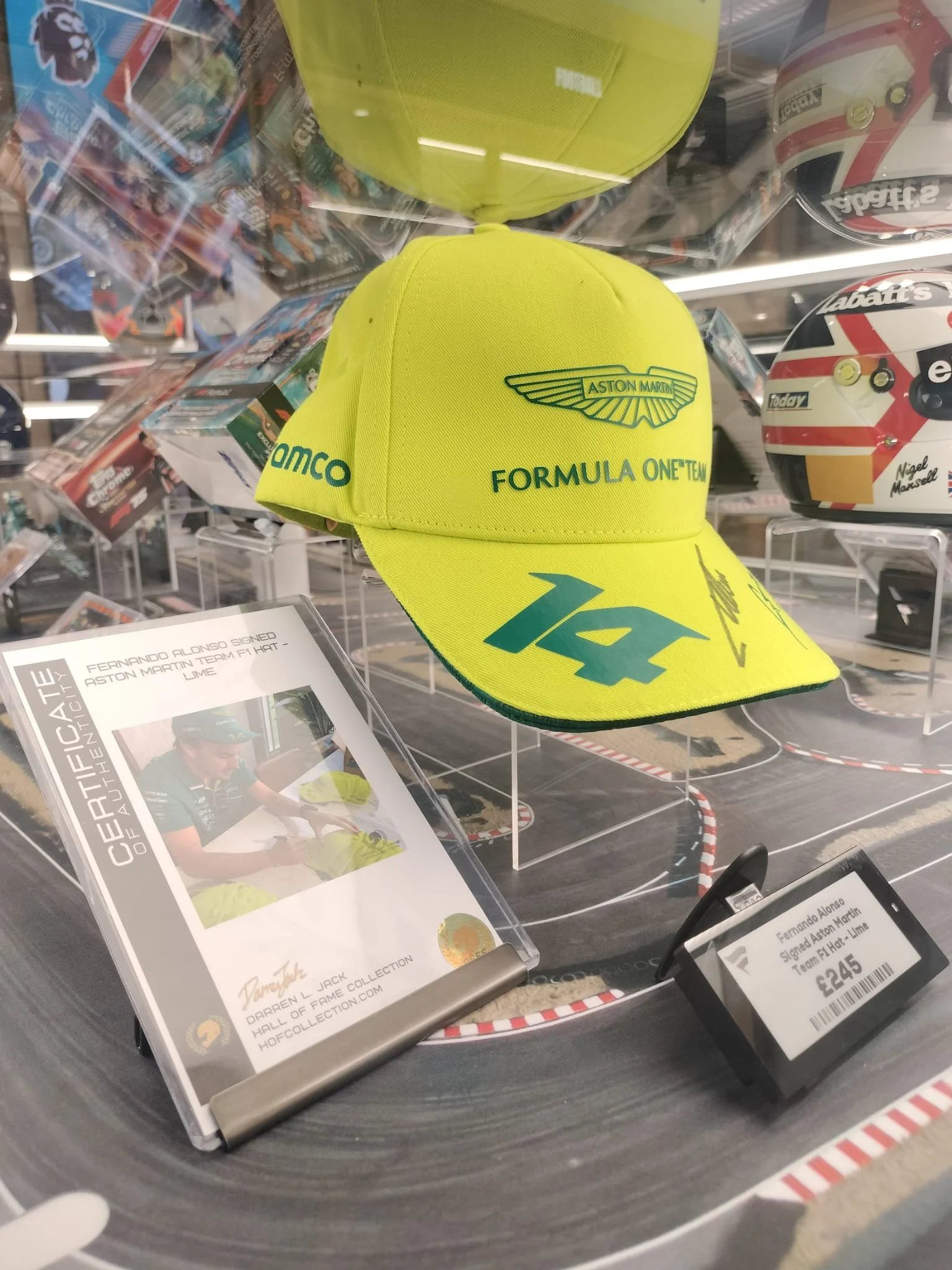
That question sits at the heart of a signed Fernando Alonso Aston Martin Formula 1 hat currently associated with the Hall of Fame Collection and photographed at a displayed price of £245. The item is a lime-coloured Aston Martin F1 team hat signed by Fernando Alonso, accompanied by certification of authenticity. Hall of Fame Collection currently lists the same titled item, “Fernando Alonso Signed Aston Martin Team F1 Hat - Lime,” for US$300, describing it as an official Aston Martin driver cap hand-signed by the two-time Formula 1 World Champion and supplied with a Certificate of Authenticity. (Hall of Fame Collection)
For The Ashalon, this is exactly the kind of object that creates an interesting debate about collecting versus investing.
Is £245 cheap?
Is £245 expensive?
Could the hat be worth more in ten years?
Could it be worth less?
Nobody can honestly guarantee those answers.
But there is one answer that a collector can control: whether the object means something to them.
And that may be more important than the eventual resale price.
The object itself: a piece of Formula 1 memorabilia
The photographed item is visually striking.
The bright lime Aston Martin colour immediately connects it to the team's modern identity, while the autograph transforms what would otherwise be ordinary team merchandise into a piece of signed sporting memorabilia. The cap is accompanied by a certificate describing it as a Fernando Alonso signed Aston Martin Team F1 Hat, with the displayed price shown as £245. That distinction matters. There is an enormous difference between buying an ordinary Formula 1 hat and buying an authenticated signed piece of Formula 1 memorabilia. Fanatics currently sells ordinary Fernando Alonso Aston Martin merchandise, including an official Fernando Alonso Aston Martin F1 adjustable driver hat, showing how widely available standard Alonso-branded apparel can be. (Fanatics) The signed hat occupies a different category. It contains an additional layer of human association. The value is not simply in the fabric, stitching, logo or colour. It is in the connection between the physical object and the person whose signature appears upon it. That is the beginning of the collector's story.
Why Fernando Alonso matters to collectors
Fernando Alonso is not simply another name printed on Formula 1 merchandise. He is a two-time Formula 1 World Champion and remains one of the most recognisable drivers of his generation. Formula 1 continues to describe him as a two-time World Champion, and his career has extended across multiple major eras of the sport. (Formula 1® - The Official F1® Website) His association with Aston Martin also gives this particular piece a specific historical context. Alonso joined Aston Martin during the modern era of the team's development, and in 2026 he remains part of the Aston Martin Formula 1 story. Formula 1 reported in June 2026 that Alonso scored Aston Martin's first point of the 2026 season in Monaco, while later reporting highlighted questions surrounding his future beyond 2026. (Formula 1® - The Official F1® Website) That uncertainty is interesting from a collecting perspective. A signed object does not merely represent a driver.
It can represent a period.
A collector buying an Alonso Aston Martin hat today is not simply buying an autograph. They are buying an object associated with a particular chapter of Alonso's career and Aston Martin's Formula 1 journey. That is precisely why tangible memorabilia can become interesting historical objects.
The difference between an investment and a collectible
This is where The Ashalon would make an important distinction, An investment is generally purchased with the expectation that it will produce a financial return.A collectible can have financial value, but its emotional, cultural or historical value may be equally important.The two categories overlap.They are not identical.A collector can therefore make a terrible financial investment and still make an excellent collecting decision.Imagine buying the Alonso hat for £245. Ten years later, perhaps the market value is £150.
Financially, that would not be a successful investment.
But imagine that during those ten years the collector watched hundreds of Formula 1 races while the hat sat in their home office. Imagine that they attended a Grand Prix wearing it. Imagine that their children grew up seeing it displayed. Imagine that Fernando Alonso eventually retired and the hat became one of the objects that reminded the family of the era in which they followed Formula 1 together.
Has the object really lost £95 of value?
Financially, perhaps.Personally, perhaps not. This is the philosophy The Ashalon wants collectors to consider.
Not everything needs to be flipped.
The danger of turning everything into an investment
The modern collectibles market increasingly encourages people to ask one question:
"What can I sell this for?"
The Ashalon believes that question can destroy the joy of collecting. If every object is purchased only because somebody believes it will increase in value, collecting becomes a form of speculation. The collector stops asking whether they like the object. They start asking whether another person will like it more. That distinction is enormous. A person might purchase a signed Fernando Alonso hat because they have followed Alonso since his Renault years, watched his battles with Michael Schumacher, followed his Ferrari period, admired his return to Formula 1 and now want something connected to his Aston Martin chapter.
That is collecting.
Another person might purchase the exact same hat because they believe Alonso will retire, his autograph will become more desirable and the hat will supposedly double in price. That is speculation. Neither approach is inherently wrong. But The Ashalon believes the first is healthier.
What makes the £245 price interesting?
The photographed price of £245 deserves examination. The question is not simply whether £245 is "cheap."
The correct question is:
£245 compared with what?
Hall of Fame Collection currently lists the same named Fernando Alonso Signed Aston Martin Team F1 Hat - Lime at US$300. The seller describes the item as an official Aston Martin driver cap signed by Alonso and states that it comes with a Certificate of Authenticity. (Hall of Fame Collection) That provides useful market context. It does not prove that £245 is an investment bargain. It does, however, suggest that the displayed £245 price should not automatically be viewed as unreasonable simply because the item is a hat. The market is pricing the object as signed motorsport memorabilia rather than ordinary apparel.
That distinction is crucial.
A normal Aston Martin F1 hat can be purchased for a comparatively modest amount. Fanatics currently lists a standard Fernando Alonso Aston Martin F1 driver adjustable hat at US$54.50, illustrating the premium created by the autograph and associated authentication. (Fanatics)
The collector is therefore paying for something beyond the hat. They are paying for association, authenticity and story.
Authentication is one of the most important considerations
This is where the collector should slow down. A signature by itself is not enough. The market for signed sports memorabilia depends heavily upon authenticity and provenance. Hall of Fame Collection states that its products come with Certificates of Authenticity and presents authenticity as one of its core services. (Hall of Fame Collection) That does not mean a collector should blindly buy anything bearing a certificate.
A sensible collector should still preserve:
The original receipt
The Certificate of Authenticity
Product descriptions
Photographs
Packaging
Any identifying numbers or labels
Purchase date
Seller information
Provenance information
Photographs of the signature
Photographs of the complete object
The certificate should remain with the object. If the hat eventually becomes part of a museum collection, estate collection or family archive, that documentation can become almost as important as the physical hat itself. This is exactly where The Ashalon's philosophy of tangible assets plus documentation becomes relevant.
A hat can become a historical object
Calling a hat a historical object may initially sound excessive but history is full of objects that were once ordinary.
A letter was once simply a letter. A photograph was once simply a photograph.A watch was once something somebody wore.A football shirt was once simply sportswear. A concert ticket was once something that allowed somebody through a door.Time changes the meaning of objects.The same principle applies to Formula 1 memorabilia. A hat associated with a major driver during a particular era can potentially become a physical reminder of that era.The important word is potentially. Not every hat will become rare. Not every autograph will appreciate. Not every Formula 1 collectible will become valuable but that uncertainty is precisely why collectors should buy things they genuinely want.
The Ashalon's argument: buy the memory, not the future price
This is perhaps the central argument of the entire article.
Buy the memory.
If you are a Fernando Alonso fan, and you have £245 available for a collectible, you might look at this hat and immediately remember why you started watching Formula 1.
Maybe it was Alonso's Renault years.
Maybe it was the Ferrari era.
Maybe you discovered him through Drive to Survive.
Maybe you watched his Aston Martin comeback.
Maybe you simply admire his longevity.
Whatever the reason, that emotional connection is yours.
Nobody can take it away.
And unlike a digital image stored on a phone, the physical hat occupies space in your world.
You can display it.
You can touch it.
You can photograph it.
You can take it to an event.
You can eventually pass it to someone else.
That is tangible collecting.
The investment case is much weaker
If someone asked The Ashalon:
"Should I buy this purely as an investment?"
The answer would be considerably more cautious.
No.
Not purely for that reason.
There are too many variables.
The future value of signed sports memorabilia depends upon supply, demand, the driver's legacy, authentication, condition, market sentiment, collector demographics and the availability of comparable pieces.
Fernando Alonso's eventual retirement could change interest in his memorabilia.
His future achievements could change it.
The growth or contraction of Formula 1's global audience could change it.
The popularity of Aston Martin could change it.
The market for signed memorabilia itself could change.
There is no guaranteed trajectory.
Even the same seller's current catalogue demonstrates the enormous range of Formula 1 memorabilia values. Hall of Fame Collection lists signed Alonso hats around the $300 level while much more substantial objects, such as signed helmets and race-used memorabilia, command dramatically higher prices. (Hall of Fame Collection)
That tells us something important.
Not all memorabilia is equal.
A hat should not be evaluated as though it were a race-used helmet.
Why the hat could still be an excellent collectible
The fact that the investment case is uncertain does not make the object unattractive.
Quite the opposite.
For the right collector, it could be an excellent purchase.
There are several reasons.
First, it is associated with a globally recognised Formula 1 driver.
Second, it carries Aston Martin branding, linking it to a major automotive marque.
Third, it is signed.
Fourth, it comes with certification from the seller.
Fifth, it is relatively easy to display.
Sixth, it does not require a huge amount of physical space.
Seventh, it can be enjoyed rather than stored in a vault.
That last point matters.
A collectible that you can actually enjoy is fundamentally different from an asset that exists only inside a spreadsheet.
The case for buying as a fan
The Ashalon would therefore make a surprisingly simple recommendation.
If you are an Alonso fan and you have the disposable money, buy it because you want it.
Do not buy it because somebody on social media told you it will be worth £1,000.
Do not buy it because you believe retirement automatically makes every autograph valuable.
Do not buy it because you think Formula 1 memorabilia is guaranteed to rise.
Buy it because you want Fernando Alonso's signature on an Aston Martin F1 hat in your collection.
That is a much stronger reason.
And if the item eventually increases in value, that becomes a bonus.
Stop flipping everything
There is a broader collecting philosophy behind this.
The modern internet has made it incredibly easy to flip things.
Buy.
List.
Sell.
Repeat.
The collector can become trapped in an endless cycle of searching for the next arbitrage opportunity.
There is nothing inherently wrong with trading collectibles.
The Ashalon itself operates within the world of tangible assets.
But there is something valuable about keeping things.
A collection is created through accumulation.
A museum is created through preservation.
An estate is created through time.
If everything is sold the moment its price rises, nothing remains.
That is why The Ashalon believes people should sometimes resist the temptation to sell.
Keep the things that matter.
The museum principle
This philosophy is particularly relevant to The Ashalon's Museum Collection.
A museum collection is not simply a pile of objects.
It is a record of decisions.
Someone decided that a particular object was worth preserving.
Someone documented it.
Someone stored it.
Someone protected it.
And eventually, someone else may inherit it.
The Alonso hat fits naturally into this broader philosophy.
It could become part of a collection documenting modern Formula 1 culture.
Not because it is necessarily the most expensive object.
Not because it is necessarily rarest.
But because it represents a moment in sporting history.
The Ashalon Museum concept is therefore not simply about accumulating expensive objects.
It is about building a physical archive.
What happens if Fernando Alonso retires?
This is where the speculative argument becomes interesting without becoming a prediction.
Alonso is already a two-time World Champion.
He has raced for some of the most recognisable teams in Formula 1.
His career has crossed generations of the sport.
And in 2026, Formula 1 reporting has focused on his future as his contract situation develops. (Formula 1® - The Official F1® Website)
Eventually, every driver becomes a former driver.
That transition can change collecting behaviour.
Fans who watched a driver compete every weekend suddenly begin looking backwards.
The helmet becomes historical.
The race suit becomes historical.
The photographs become historical.
The signed merchandise becomes historical.
But again, this does not mean the value automatically increases.
That distinction must remain clear.
A collector can reasonably believe retirement may strengthen interest without pretending that appreciation is guaranteed.
The Aston Martin connection may become increasingly interesting
There is another element that makes the hat worth considering.
It is not simply an Alonso hat.
It is an Alonso Aston Martin hat.
That gives it a dual identity.
It belongs to the story of Fernando Alonso.
It also belongs to the story of Aston Martin's Formula 1 programme.
That creates an interesting collecting intersection between motorsport, automotive history and celebrity memorabilia.
A collector interested in Alonso might want it.
An Aston Martin collector might want it.
A Formula 1 memorabilia collector might want it.
A signed sports memorabilia collector might want it.
That doesn't guarantee scarcity, but it creates several potential collecting audiences.
And that is one of the characteristics The Ashalon looks for when considering tangible heritage assets.
The collector should think about condition
There is another practical consideration.
If you buy the hat, do not treat it like an ordinary hat.
If the autograph is the primary reason for purchasing the item, excessive wear can damage the presentation and potentially affect collector interest.
Keep it away from direct sunlight.
Avoid unnecessary handling.
Keep the certification with it.
Do not casually wear it to every Grand Prix.
That may sound almost contradictory.
You buy something because you love it, but then you are told not to use it.
The answer is to find a balance.
The collector might display it inside a UV-protected case, for example, while preserving the original certificate and packaging separately.
The objective is not to turn the object into something sterile.
It is to make sure that your enjoyment today does not destroy its condition tomorrow.
Don't forget the story
Perhaps the most valuable thing you can add to the hat is something that costs almost nothing.
Write down why you bought it.
Put the date in your collection records.
Record where you purchased it.
Record the price.
Record the seller.
Record the certificate details.
Then write a paragraph explaining why Fernando Alonso mattered to you.
That document could eventually become part of the asset.
Imagine someone opening the collection twenty years from now.
They see the signed lime Aston Martin hat.
Next to it is a note:
"I bought this because I followed Alonso throughout his Formula 1 career and wanted something from his Aston Martin era."
Suddenly the object has become more than merchandise.
It has become family history.
That is what The Ashalon means by a legacy asset.
£245 for a memory?
There is an argument that £245 is too much for a hat.
There is also an argument that £245 is very little for a signed piece of Formula 1 history.
Both arguments can be made.
But they miss the point.
The correct price for an object depends partly on the person buying it.
If someone has no interest in Formula 1, £245 may be absurd.
If someone has followed Alonso for twenty years, owns an Aston Martin collection and has wanted an authenticated Alonso autograph for years, £245 may feel completely reasonable.
Collecting is personal.
The market can establish a price.
But only the collector can establish meaning.
What The Ashalon would do
If The Ashalon were evaluating the hat as part of a collection, it would not classify it as a guaranteed financial investment.
It would classify it as signed motorsport memorabilia with potential long-term collectible and historical interest.
That is a much more honest description.
The Ashalon would also want the provenance preserved.
The certificate would be archived.
The original purchase information would be recorded.
The object would be photographed.
Its condition would be documented.
And the hat would be stored appropriately.
If the collector genuinely loved Fernando Alonso and could comfortably afford £245 without compromising essential finances, The Ashalon would have no problem with the purchase.
In fact, The Ashalon would encourage the collector to consider keeping it.
Collecting should not become a second job
There is a psychological trap in modern collecting.
Once you start thinking about resale values, every object becomes a potential transaction.
You buy a watch and immediately check Chrono24.
You buy a coin and immediately check auction results.
You buy a card and immediately search completed sales.
You buy a signed hat and immediately ask whether it could appreciate.
At some point, the collection stops being yours.
It becomes an inventory.
The Ashalon believes that distinction matters.
A collection should contain objects that tell you something about yourself.
Your interests.
Your memories.
Your family.
Your history.
Your ambitions.
Your experiences.
If you eventually sell something, that is perfectly legitimate.
But you should not have to sell everything.
The real value of tangible assets
This is one of the central philosophies behind The Ashalon.
We are moving through an increasingly digital world.
Photos live in clouds.
Tickets live inside apps.
Music exists on streaming platforms.
Games can exist entirely as downloads.
Financial assets can exist as database entries.
Identity can increasingly exist digitally.
That makes physical objects interesting.
A signed hat is physical.
You can hold it.
You can display it.
You can preserve it.
You can pass it down.
It occupies physical space in the world.
The autograph is physically present.
The fabric is physically present.
The certificate is physically present.
The memory is attached to something tangible.
That is powerful.
The Ashalon does not believe everything needs to appreciate
This point deserves repeating.
A collectible does not have to become more expensive to become more valuable to you.
A childhood toy can become priceless because of memory.
A parent's watch can become priceless because of inheritance.
A photograph can become priceless because of the person in it.
A football shirt can become priceless because of the match associated with it.
A signed Formula 1 hat can become priceless because it reminds you of the driver you followed for decades.
Financial value and personal value are different measurements.
The best collections understand both.
So, should you buy the Fernando Alonso hat?
The Ashalon's answer is:
Buy it if you are buying Fernando Alonso.
Not literally the person.
The story.
The career.
The Aston Martin chapter.
The Formula 1 memories.
The era.
The autograph.
The object.
The experience of owning something tangible connected to a sport you love.
Do not buy it if you are only buying £245 today in the hope of selling it for £500 tomorrow.
That is speculation, not collecting.
There is nothing wrong with speculation when done responsibly, but it should be recognised for what it is.
If the hat increases in value, excellent.
If it remains around £245, you still have something you love.
If its financial value falls, you have hopefully still enjoyed owning it.
That is a much healthier relationship with collecting.
From merchandise to legacy asset
This is where the hat becomes particularly interesting to The Ashalon.
Today, it is a signed Formula 1 cap.
Tomorrow, it could be part of somebody's personal collection.
Years from now, it could be part of a family archive.
Eventually, it could become a historical artefact representing a specific period of Fernando Alonso's career and Aston Martin's Formula 1 journey.
None of that is guaranteed.
But that is how collections are created.
Someone has to make the first decision to preserve something.
The collector who buys the hat today becomes part of that process.
The collector's life should not be a spreadsheet
The Ashalon believes there is a simple philosophy worth remembering:
You cannot take your collection with you forever, but you can leave it behind.
That changes the way we should think about ownership.
The point is not necessarily to own the maximum amount.
The point is to own things that matter.
A signed Fernando Alonso Aston Martin F1 hat might never become a six-figure piece.
It does not need to.
It can simply be a brilliant piece of Formula 1 memorabilia sitting in a collector's home.
It can remind somebody of races watched late at night.
It can remind somebody of the first time they visited a Grand Prix.
It can become something their child associates with their parent's passion for Formula 1.
And one day, that child may inherit the hat.
At that moment, its real value becomes obvious.
The Ashalon's final verdict
At £245, the photographed Fernando Alonso Aston Martin signed hat is not something The Ashalon would describe as a guaranteed investment.
There is no responsible way to make that promise.
The item is also not particularly interesting simply because it is a hat.
Its appeal comes from the combination of Fernando Alonso, Aston Martin, Formula 1, the autograph, authentication and the story attached to the object. Hall of Fame Collection's current listing gives the item a US$300 reference price and states that it comes with a Certificate of Authenticity, while its broader catalogue demonstrates that signed Alonso memorabilia spans a wide range of formats and prices. (Hall of Fame Collection)
But The Ashalon would make the case for buying it anyway—if you are a genuine fan.
Buy it because you have followed Alonso.
Buy it because you love Aston Martin.
Buy it because Formula 1 means something to you.
Buy it because you want one physical object from this era of the sport.
Buy it because you want to start a collection.
Buy it because you want something that your children might one day ask you about.
But do not buy it simply because you think somebody else will pay more.
Collecting should be about ownership before speculation.
That is the philosophy The Ashalon applies to tangible heritage assets.
The best collectible is not necessarily the one with the highest price tag.
Sometimes it is the object you would refuse to sell.
The Ashalon: Collect What Matters
The Ashalon believes that the future of collecting will not simply be about finding objects that increase in financial value.
It will be about finding objects that retain meaning.
A gemstone.
A historical document.
A coin.
A watch.
A photograph.
A game console.
A family heirloom.
Or a signed Formula 1 hat.
These objects can become part of a personal museum of life and perhaps that is the real lesson of the Fernando Alonso hat.
Don't spend your entire life flipping everything you own.
Sometimes, buy something because you love it.
Keep it.
Protect it.
Document it.
Tell its story.
Then, years from now, you may discover that you did not merely buy a collectible and you preserved a piece of your own history. That is the kind of ownership The Ashalon wants to encourage: Freedom. Assets. Control. And sometimes, the smartest thing a collector can do with an object they genuinely love is simply keep it.
References
Hall of Fame Collection, Fernando Alonso Signed Aston Martin Team F1 Hat - Lime — current product listing and authentication information. (Hall of Fame Collection)
Hall of Fame Collection, Aston Martin Collection — current selection of Alonso/Aston Martin signed memorabilia and comparative pricing. (Hall of Fame Collection)
Fanatics, Fernando Alonso Aston Martin merchandise — current official merchandise listings, including the standard Alonso Aston Martin F1 adjustable hat. (Fanatics)
Formula 1, How Aston Martin's 'aggressive and ambitious' strategy earned them a first point of 2026 — Alonso's 2026 Aston Martin context. (Formula 1® - The Official F1® Website)
Formula 1, There are more things on the table – Fernando Alonso insists Aston Martin's Hungary upgrade will not decide his future — Alonso's 2026 contract/future context. (Formula 1® - The Official F1® Website)
Formula 1, 2026 F1 Driver Numbers — confirmation of Alonso's status as a two-time World Champion and his #14 racing number. (Formula 1® - The Official F1® Website)