 Image 1 of 2
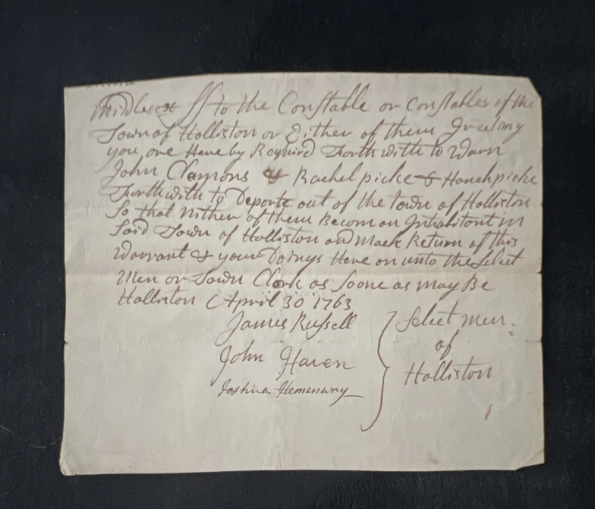 Image 2 of 2
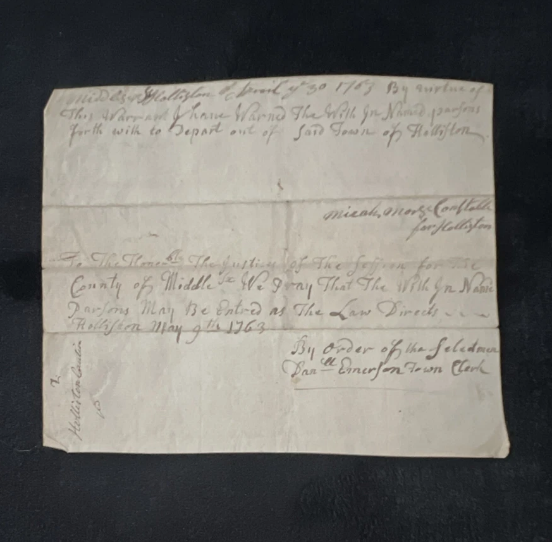
An exceptionally rare 263-year-old handwritten legal document dating to April 30, 1763, during the reign of King George III.
This original manuscript note appears to be a constable's warrant issued in the town of Holliston (Holliston/Hollington spelling variations are common in period documents), Hampshire, England. Written entirely by hand in iron-gall ink on laid paper, the document instructs local constables to remove or return named individuals who had departed from the parish without authorization.
The text references John Chaynors and Rachel Pickers of Hampshire, and bears the signatures of several local officials, including James Russell, John Haven, and Joshua Hemenway, identified as selectmen of Holliston.
Dating from 30 April 1763, this fascinating piece was created in the same year that the Treaty of Paris officially ended the Seven Years' War, making it a genuine artifact from a pivotal period of British and world history.
Original handwritten manuscript dated 1763
Written in period cursive script with brown iron-gall ink
References local government and constabulary administration
Signed by multiple town officials
Authentic 18th-century laid paper
Excellent research potential for historians and genealogists
A remarkable display piece for collectors of colonial and Georgian-era documents
The document remains in good antique condition for its age, with expected signs of handling and storage accumulated over more than two and a half centuries. Ink remains legible and signatures are clearly visible. Please review photographs carefully for detailed condition assessment.
Original English local-government manuscripts from the mid-18th century are increasingly difficult to find. This document offers a tangible connection to everyday law enforcement, parish administration, and community governance in Georgian Britain. It would make an outstanding addition to a collection of early manuscripts, legal documents, genealogy material, or British historical ephemera.
A genuine 18th-century survivor—written by hand over 260 years ago and preserved into the modern era.
An exceptionally rare 263-year-old handwritten legal document dating to April 30, 1763, during the reign of King George III.
This original manuscript note appears to be a constable's warrant issued in the town of Holliston (Holliston/Hollington spelling variations are common in period documents), Hampshire, England. Written entirely by hand in iron-gall ink on laid paper, the document instructs local constables to remove or return named individuals who had departed from the parish without authorization.
The text references John Chaynors and Rachel Pickers of Hampshire, and bears the signatures of several local officials, including James Russell, John Haven, and Joshua Hemenway, identified as selectmen of Holliston.
Dating from 30 April 1763, this fascinating piece was created in the same year that the Treaty of Paris officially ended the Seven Years' War, making it a genuine artifact from a pivotal period of British and world history.
Original handwritten manuscript dated 1763
Written in period cursive script with brown iron-gall ink
References local government and constabulary administration
Signed by multiple town officials
Authentic 18th-century laid paper
Excellent research potential for historians and genealogists
A remarkable display piece for collectors of colonial and Georgian-era documents
The document remains in good antique condition for its age, with expected signs of handling and storage accumulated over more than two and a half centuries. Ink remains legible and signatures are clearly visible. Please review photographs carefully for detailed condition assessment.
Original English local-government manuscripts from the mid-18th century are increasingly difficult to find. This document offers a tangible connection to everyday law enforcement, parish administration, and community governance in Georgian Britain. It would make an outstanding addition to a collection of early manuscripts, legal documents, genealogy material, or British historical ephemera.
A genuine 18th-century survivor—written by hand over 260 years ago and preserved into the modern era.